As businesses accelerate their digital transformation, the tools they use to manage customers and internal processes have evolved significantly. ServiceNow has emerged as a dominant force in enterprise software, widely recognized for its IT Service Management (ITSM) capabilities. But with its expanding portfolio of solutions, a common question arises:
Is ServiceNow a CRM?
The answer is not straightforward. While ServiceNow offers certain customer management functionalities, it is not a traditional CRM in the mold of Salesforce, HubSpot, or Zoho CRM. Instead, ServiceNow is best understood as a platform for digital workflow automation, with CRM-adjacent capabilities tailored to specific industries and service operations.
In this article, we’ll explore the distinctions, overlap, and use cases of ServiceNow vs. traditional CRMs, and whether it can serve your organization’s customer management needs.
What is ServiceNow? A High-Level Overview
ServiceNow is a cloud-based workflow automation platform that enables businesses to manage digital workflows across IT, HR, security, customer service, and more. Its core strength lies in automating and optimizing complex processes that span departments.
Key modules include:
- IT Service Management (ITSM)
- Customer Service Management (CSM)
- HR Service Delivery
- Security Operations
- Governance, Risk, and Compliance (GRC)
Unlike traditional CRMs focused mainly on sales and marketing, ServiceNow is primarily used for service operations and support workflows.
Does ServiceNow Function as a CRM?
What Makes a CRM?
To determine whether ServiceNow qualifies as a CRM, let’s recall the core components of a Customer Relationship Management system, which typically include:
- Contact and lead management
- Sales pipeline tracking
- Marketing automation
- Opportunity and deal forecasting
- Customer interaction history
- Reporting and analytics
Now, let’s compare this with ServiceNow’s capabilities.
ServiceNow’s CRM-Like Capabilities
1. Customer Service Management (CSM)
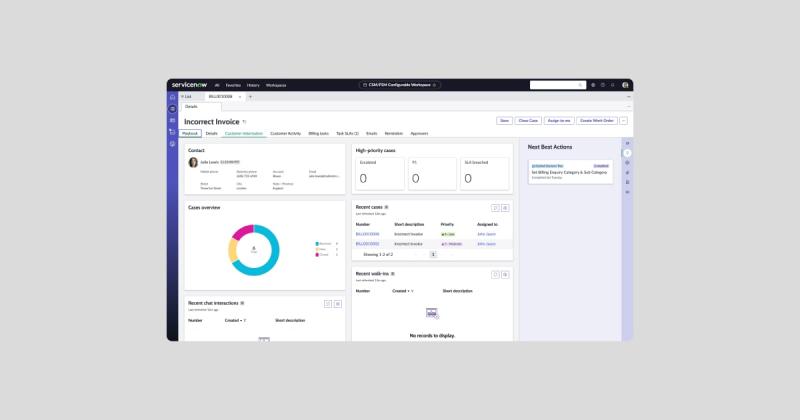
ServiceNow’s Customer Service Management module is the closest it gets to a CRM. It allows organizations to:
- Manage customer cases and service requests
- Automate issue resolution using AI and workflows
- Provide omnichannel customer support (email, chat, phone, portals)
- Route requests based on priority, type, and SLA
- Access customer history and related data
This is highly valuable for post-sale service and support, but it lacks core sales-focused CRM features like pipeline tracking or lead scoring.
2. Account and Contact Management
ServiceNow CSM allows users to store and manage data related to customer accounts, contacts, assets, and contracts. This functionality supports the customer support journey, not necessarily sales engagement.
3. Omnichannel Customer Engagement
ServiceNow integrates with chatbots, self-service portals, virtual agents, and contact centers, offering a consistent customer experience across all support channels.
4. Case and Incident Management
Unlike traditional CRMs that focus on sales stages, ServiceNow emphasizes incident and case resolution. It tracks the lifecycle of a customer issue from intake to resolution, complete with workflows, task assignments, SLAs, and escalation rules.
5. Integration with Other Platforms
ServiceNow can be integrated with platforms like Salesforce, Microsoft Dynamics, SAP, and HubSpot, allowing organizations to bridge the gap between customer service and sales workflows.
What ServiceNow Doesn’t Offer Compared to Traditional CRMs
❌ No Built-In Sales Pipeline Management
ServiceNow lacks native tools for managing sales funnels, opportunity stages, or revenue forecasting — a core function of CRMs like Salesforce and Pipedrive.
❌ No Lead or Marketing Automation
There are no tools for lead generation, email marketing campaigns, lead nurturing, or scoring built into ServiceNow. While integrations can cover some of these needs, they are not native.
❌ No Focus on Pre-Sale Customer Journey
Most CRM platforms track a customer from the first touchpoint through to conversion. ServiceNow is primarily concerned with post-sale service, issue resolution, and operational workflows.
ServiceNow vs. CRM Platforms: Side-by-Side Comparison
| Feature | ServiceNow | Salesforce CRM | HubSpot CRM | Zoho CRM |
|---|---|---|---|---|
| Contact Management | ✅ | ✅ | ✅ | ✅ |
| Case Management | ✅ | ✅ | ✅ | ✅ |
| Sales Pipeline | ❌ | ✅ | ✅ | ✅ |
| Marketing Automation | ❌ | ✅ | ✅ | ✅ |
| Post-Sale Service Focus | ✅ | ✅ | ✅ | ✅ |
| Workflow Automation | ✅ | Limited | Limited | Moderate |
| IT & Enterprise Workflow | ✅ | ❌ | ❌ | ❌ |
| Integrations with CRMs | ✅ | N/A | N/A | N/A |
Who Should Use ServiceNow Instead of a CRM?
ServiceNow is ideal for enterprises and mid-to-large organizations with complex service operations and a need to:
- Automate support workflows across departments
- Deliver excellent post-sale service and customer care
- Provide self-service portals and AI-driven resolutions
- Integrate service data with broader enterprise systems
It’s an excellent solution for organizations in:
- Telecommunications
- Healthcare
- Banking and Financial Services
- Retail and E-commerce
- Government and Public Sector
However, if your main focus is sales, marketing, or customer acquisition, then ServiceNow alone will not meet your CRM needs.
Combining ServiceNow with a CRM: The Best of Both Worlds
Many organizations opt to integrate ServiceNow with traditional CRMs to create an end-to-end customer experience pipeline. This model allows:
- Sales teams to work in Salesforce or HubSpot
- Customer service teams to manage tickets and issues in ServiceNow
- All teams to access a unified view of the customer
Using APIs, middleware, or tools like MuleSoft and Zapier, organizations can sync customer data between platforms for improved efficiency.
Final Verdict: Is ServiceNow a CRM?
No, ServiceNow is not a traditional CRM, but it does offer CRM-like functionality in the area of Customer Service Management. It is more accurately categorized as a Digital Workflow and Service Operations Platform that enhances customer support, not sales or marketing efforts.
That said, in environments where customer experience, service resolution, and workflow automation are top priorities, ServiceNow can be an invaluable tool — especially when integrated with a dedicated CRM.